

LED vs Halogen Lights: Differences, Pros, Cons, and Which Is Better?

LEDs and halogens represent fundamentally different lighting technologies. Halogens use heated tungsten filaments surrounded by halogen gas to produce light through incandescence, while LEDs generate light through electroluminescence in semiconductors.
LEDs dramatically outperform halogens in nearly every metric. They convert 80-90% of energy into light versus halogen’s mere 10-20%, producing 80-100 lumens per watt compared to halogen’s 16-24. An average LED uses just 8 watts while halogens consume 90 watts for equivalent brightness—over 12 times more power.
LEDs last 25,000-50,000 hours versus halogen’s 2,000-4,000 hours, outlasting 12-25 halogen bulbs. While LEDs cost more upfront (up to 10 times higher), they save over $200 per bulb over 10 years through reduced energy and replacement costs.
Safety differences are critical: halogens reach 970-1,200°F and have caused at least 30 fires and two deaths, while LEDs remain cool at 140-176°F. Halogens achieve perfect 100 CRI color rendering, though quality LEDs now reach 90-98 CRI with greater color temperature flexibility (1,800K-6,500K versus halogen’s fixed 3,000K).
Environmental impact favors LEDs, with one bulb reducing emissions by nearly half a ton over its lifetime. U.S. regulations effectively banned halogen sales starting August 2023, making LEDs the clear choice for modern lighting needs.
What is a Halogen Light?
A halogen light is an advanced incandescent bulb that contains halogen gas (usually iodine or bromine) surrounding a tungsten filament, which significantly extends its lifespan compared to traditional incandescent bulbs. When electricity passes through the tungsten filament, it heats up to around 2,500°C and produces bright, warm white light with excellent color rendering. The halogen gas creates a chemical cycle that redeposits evaporated tungsten back onto the filament, preventing blackening and allowing the bulb to operate at higher temperatures for brighter output.
These lights produce instant full brightness without warm-up time, emit light in all directions (360-degree beam), and generate substantial heat as a byproduct of their operation. Halogen bulbs typically last 2,000–4,000 hours, operate at 110–130 volts in household applications, and convert only 10–20% of energy into visible light while the rest becomes heat.
What Is an LED Light?
An LED (Light Emitting Diode) light is a semiconductor device that produces light through electroluminescence when electrical current passes through a microchip, exciting tiny light sources called diodes that emit photons without generating excessive heat. Unlike filament-based bulbs, LEDs create light through electron movement within the semiconductor material—typically combining elements such as gallium, arsenic, and phosphorus—making them highly energy-efficient by converting 80–90% of electricity directly into visible light. The technology uses a heat sink to absorb and dissipate any heat produced by the diodes, ensuring optimal performance and longevity throughout a lifespan of 25,000–50,000 hours.
LED lights require driver circuits to convert AC power to the low-voltage DC power they need and produce directional light that can be precisely focused or diffused using lenses. They offer instant illumination with no warm-up period while remaining cool to the touch during operation. Available in a wide range of color temperatures—from warm (2,700K) to cool (6,500K)—LEDs maintain consistent brightness over time and contain no mercury or hazardous materials, making them an environmentally safer alternative to traditional lighting options.
What is the Difference Between LED and Halogen Lights?
The differences between LED and halogen lights are outlined in the table below:
Attribute | LED Light | Halogen Light |
Light Generation Method | Electroluminescence (semiconductor) | Incandescence (heated tungsten filament) |
Energy Efficiency | High | Low |
Power Consumption | Low (≈ 5–15 W equivalent) | High (≈ 35–100 W) |
Luminous Efficacy | High (80–150 lm/W) | Low (15–25 lm/W) |
Brightness per Watt | High | Low |
Lifespan | Long (15,000–50,000 hours) | Short (2,000–4,000 hours) |
Heat Emission | Low | Very High |
Operating Temperature | Cool | Hot |
Warm-Up Time | Instant | Instant |
Dimmability | Yes (with compatible driver) | Yes |
Color Temperature Range | Wide (2700K–6500K+) | Limited (mostly warm ~3000K) |
Color Rendering Index (CRI) | High (80–95+) | Very High (≈100) |
Maintenance Frequency | Low | High |
Operating Cost | Low | High |
Initial Cost | Higher | Lower |
Total Cost of Ownership | Low | High |
Environmental Impact | Lower | Higher |
Carbon Emissions | Low | High |
Mercury Content | None | None |
Durability | High (shock-resistant) | Low (fragile filament) |
Voltage Sensitivity | Low | High |
Typical Applications | Residential, commercial, industrial, smart lighting | Accent lighting, stage lighting, ovens |
Replacement Trend | Increasing adoption | Being phased out |
Energy efficiency
LED lights convert 80–90% of electrical energy directly into visible light with minimal waste, while halogen bulbs convert only 10–20% of energy into light, with the vast majority wasted as heat through their incandescent filament-based operation.
LEDs produce 80–100 lumens per watt compared to halogen’s 16–24 lumens per watt, delivering four to five times more light output per unit of electricity consumed.
This dramatic efficiency gap stems from fundamentally different light-generation methods—LEDs use electroluminescence through semiconductors that directly convert electricity to photons, while halogens rely on heating a tungsten filament to incandescence, an inherently wasteful thermal process requiring immense energy just to reach operating temperature before producing any useful light.
Power consumption
An average LED light uses approximately 8 watts, while halogen lights average about 90 watts—more than 12 times as much for equivalent brightness levels—translating to immediate and substantial electricity bill reductions. A 10-watt LED bulb provides the same illumination as a 60-watt halogen lamp, demonstrating the remarkable power efficiency that makes LEDs economically superior for both residential and commercial applications.
An institution with 1,000 fixtures using 35-watt halogen MR-16 lamps consumes 35,000 watts (35 kW), while equivalent 7.5-watt LED replacement lamps consume only 7,500 watts (7.5 kW). This represents a massive 78% reduction in power consumption that compounds into thousands of dollars in annual savings for large facilities.
The lower wattage requirements of LEDs also reduce strain on electrical infrastructure, lower cooling costs (since less heat enters buildings), and enable more fixtures to operate on existing circuits without requiring expensive electrical upgrades.
Brightness (lumens)
LED technology offers superior luminous efficacy ranging from 80–100 lumens per watt compared to halogen’s 16–24 lumens per watt, producing significantly more light per watt of energy consumed. This means LEDs achieve brighter illumination even when using lower-wattage bulbs. A 15-watt LED bulb delivers the same brightness as an 85-watt halogen bulb, demonstrating how modern semiconductor technology has revolutionized lighting efficiency and performance.
A 100-watt halogen bulb produces around 1,900 lumens, while a 100-watt LED light source generates approximately 11,500 lumens—more than six times the light output at the same power level. However, residential applications typically use much lower wattages, where this ratio can vary.
LED lights achieve full brightness instantly upon activation, unlike some older lighting technologies that require warm-up periods, providing immediate maximum illumination the moment you flip the switch.
Additionally, LEDs maintain consistent brightness throughout their entire lifespan without the gradual dimming that affects halogen bulbs as their filaments degrade. This ensures spaces remain properly lit for decades, with no perceivable reduction in light output until the very end of the bulb’s operational life.
Heat Generation
Halogen lights use approximately 90% of their energy producing heat rather than light, making them potential fire hazards near combustible materials, while LEDs emit only about 10% of their energy as heat and remain cool enough to touch even after hours of continuous operation.
Tubular halogen bulbs can reach extreme temperatures, ranging from about 970°F (521°C) for 300-watt bulbs to 1,200°F (649°C) for 500-watt bulbs. In comparison, incandescent bulbs operate at roughly 340°F (171°C), while LEDs typically run at only 140–176°F (60–80°C). This dramatic temperature difference fundamentally affects both safety and usability.
Halogen downlights can generate temperatures up to 370°C, hot enough to ignite ceiling insulation, structural materials, and any flammable objects that come into contact with or are positioned near the bulb surface.
The excessive heat produced by halogens increases fire risk, raises air-conditioning costs in warm climates, causes discomfort in enclosed spaces, restricts fixture placement, and can damage heat-sensitive materials such as artwork, fabrics, and plastics. LEDs effectively eliminate these issues through their cool-running semiconductor design.
Lifespan
LED bulbs last 25,000–50,000 hours compared to halogen bulbs’ 2,000–3,000 hours, meaning a single LED can outlast 12–25 halogen bulbs over its lifetime. This dramatically reduces replacement frequency and ongoing maintenance costs.
On average, LED bulbs last 50,000 hours or more, while halogen bulbs typically last only 2,000–4,000 hours. Under typical household usage of 3–4 hours per day, this translates to decades of service for LEDs versus just one to two years for halogens.
Because LEDs can operate for 25,000 hours or longer, they require far fewer replacements than halogen bulbs, which usually fail after around 2,000 hours. This reduction in replacement frequency lowers material waste and labor costs, making LEDs especially valuable in commercial environments with hundreds or thousands of fixtures, hard-to-reach installations, or locations where maintenance is costly or disruptive.
The extended lifespan of LEDs is due to their solid-state construction with no fragile filaments, lower operating temperatures that minimize thermal stress, and strong resistance to vibration and mechanical shock. Together, these factors make LEDs the clear choice for long-term reliability, reduced maintenance burden, and a significantly lower total cost of ownership.
Color quality (CRI and color temperature)
Incandescent and halogen light sources achieve CRI ratings of 100—the maximum possible score indicating perfect color rendering identical to natural sunlight. In comparison, typical white LEDs achieve CRI values of 80 or higher, with high-quality LEDs reaching 90–98 CRI, rivaling or even matching halogen performance.
Halogen lamps naturally operate at a 3,000K color temperature with excellent color balance, while LEDs offer far greater flexibility, spanning from 1,800K to 6,500K. This allows users to choose warm white (2,700–3,000K) for comfortable residential spaces, neutral white (3,500–4,000K) for task lighting, or cool white (5,000–6,500K) for commercial and industrial environments that benefit from daylight-like illumination.
For color temperatures below 5,000K, CRI measurements compare LED sources against Planckian radiation—the full-spectrum light produced by incandescent and halogen lamps. This explains why halogens historically held an advantage in color rendering, as they served as the reference standard despite their many other drawbacks.
Modern high-CRI LEDs (90+) now successfully replicate the warm, natural color quality that made halogens popular in retail displays, art galleries, restaurants, and homes. At the same time, LEDs add key advantages such as adjustable color temperature, zero UV radiation that can damage sensitive materials, and consistent color output throughout their lifespan without the color shift caused by aging halogen filaments.
Initial cost vs long-term cost
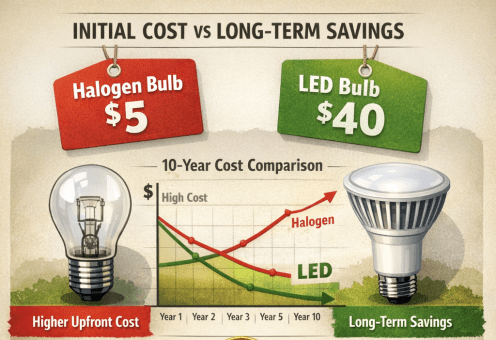
LED replacement lamps can cost up to ten times more than their halogen equivalents, depending on the lamp type. This higher upfront price creates a perceived investment barrier for some consumers, even though LEDs offer overwhelming long-term economic advantages.
Despite the initial cost, LEDs can save over $200 per bulb over a 10-year period through reduced energy consumption and fewer replacements. When total cost of ownership is considered rather than just purchase price, LEDs are dramatically more cost-effective.
After the typical one-year payback period that covers the additional LED purchase cost, users save approximately £12 (about $15) per year on electricity for each bulb replaced. These savings compound over the decades-long lifespan of LEDs, eliminating the recurring expense of replacing halogen bulbs every one to two years.
The financial benefits are even more compelling in commercial settings. Businesses with hundreds or thousands of fixtures can achieve payback periods as short as six months from energy savings alone, before accounting for reduced maintenance labor, eliminated disposal costs, lower HVAC expenses due to reduced heat output, and productivity gains from improved lighting quality.
In addition, many utility providers and governments offer rebates, tax credits, and incentive programs that further offset the initial LED investment. Combined with LED prices falling by 85–90% over the past decade, the upfront cost difference has become increasingly negligible—turning LEDs from a long-term investment into an immediate economic advantage for both households and businesses.
Environmental impact
LED lights are completely free of mercury and toxic chemicals, unlike fluorescent bulbs, making them safer to handle and dispose of while eliminating the environmental contamination risks associated with mercury-containing lighting. Although halogen bulbs also contain no mercury, their short lifespan and high energy consumption create a much larger overall environmental burden.
A single LED bulb can reduce greenhouse gas emissions by nearly half a ton over its lifetime, with annual energy consumption roughly 30 times lower than a comparable incandescent bulb. This directly reduces fossil fuel combustion at power plants and lowers emissions of carbon dioxide, sulfur dioxide, and nitrogen oxides that contribute to climate change and air pollution.
Studies indicate that widespread LED adoption has already delivered substantial environmental benefits. In 2017 alone, LEDs reduced carbon dioxide emissions associated with lighting by approximately 570 million tons, and replacing incandescent lamps with LEDs resulted in eight times fewer CO₂ emissions and 6.7 times lower energy consumption. These figures highlight the massive cumulative impact of LED technology when deployed at scale across residential, commercial, and industrial sectors.
LEDs are also highly recyclable, with components such as aluminum heat sinks and circuit boards that can be recovered and repurposed, significantly reducing landfill waste. While recycling infrastructure for LEDs is still developing, their material recovery potential is far greater than that of traditional bulbs.
Beyond operational efficiency, LEDs offer major lifecycle advantages. Their 25–50 times longer lifespan means far fewer bulbs are manufactured, packaged, transported, and discarded over the same service period, reducing resource extraction, manufacturing emissions, transportation fuel use, and end-of-life waste across the entire lighting product lifecycle.
Safety considerations
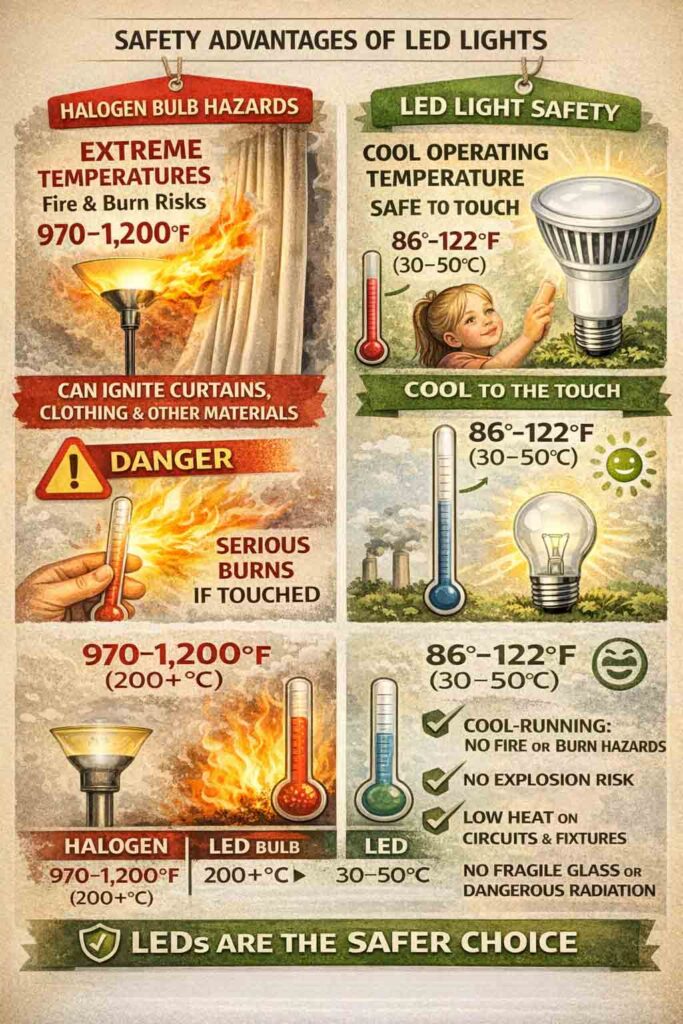
The Consumer Product Safety Commission has issued warnings about halogen bulbs reaching extremely high temperatures (970–1,200°F) that can ignite curtains, clothing, and other flammable materials. At least 30 reported fires and two deaths have been associated with torchiere lamps using tubular halogen bulbs. LEDs eliminate these fire risks entirely through their cool-running operation, which never reaches ignition temperatures.
Halogen bulbs can cause serious burns requiring medical treatment if touched while operating and may cause sunburns due to UV radiation during prolonged exposure. They pose particular dangers to small children who may accidentally come into contact with hot surfaces. In contrast, LEDs remain cool enough to touch safely even after hours of continuous use.
LED lights typically operate at surface temperatures of only 30–50°C (86–122°F) and up to about 80°C (176°F) at the base near the driver.
These temperatures are well below the approximately 300°C ignition threshold of wood and far lower than the 200°C+ operating temperatures of halogen and incandescent bulbs, making LEDs inherently safer in enclosed fixtures, near flammable materials, and in children’s rooms.
Fire authorities warn that halogen downlights can generate temperatures up to 370°C, hot enough to ignite ceiling insulation materials such as pulped paper, rock wool, fiberglass, or polyester batts if not installed with proper clearances. This requires careful installation by licensed electricians, regular inspections, and additional safety measures—requirements that LEDs largely avoid due to their minimal heat output.
The safety advantages of LEDs extend beyond heat reduction. Their lower power consumption reduces strain on wiring and electrical circuits, their solid-state construction eliminates explosion risks from pressurized bulbs, they contain no fragile filaments that can shatter into sharp glass, and they emit no harmful UV radiation that degrades materials or poses health risks. Together, these factors make LEDs the safest lighting option for virtually all residential, commercial, and industrial applications.
Which One Should You Choose LED or Halogen Lights?
For most people, the choice between LED and halogen is straightforward: LED lights are the better option in nearly all situations. They use far less energy, last much longer, run cooler, and cost significantly less over time, even if the upfront price is higher.
Choose LED lights if you want lower electricity bills, fewer bulb replacements, improved safety from low heat output, and better control over brightness and color temperature. LEDs are ideal for homes, offices, shops, outdoor lighting, and hard-to-reach fixtures. They are also the environmentally responsible choice and are increasingly required by energy regulations in many regions.
Choose halogen lights only in limited cases, such as very rarely used spaces, specific aesthetic or specialty applications, or situations where heat output is intentionally needed. Halogens are cheaper to buy initially but cost more in the long run due to high energy use and short lifespan.
Bottom line: Unless you have a very specific reason to use halogen, LED lighting is the smarter, safer, and more cost-effective choice for modern lighting needs.
Which is Better LED or Halogen Lights?
LED lights are the clear winner over halogen. They use up to 85% less energy, last 10–25 times longer, produce far less heat, and are safer, more durable, and more environmentally friendly. While LEDs cost slightly more upfront, their long lifespan and energy savings make them far cheaper over time. LEDs also offer better brightness, adjustable color temperatures, instant-on lighting, and modern features like dimming and smart compatibility. In homes, businesses, and vehicles, LED technology has decisively surpassed halogen in performance, cost-effectiveness, safety, and sustainability.
Is Halogen The Same As LED?
No, halogen and LED are fundamentally different technologies—halogen bulbs produce light by heating a tungsten filament surrounded by halogen gas, while LEDs generate light through electroluminescence in semiconductor materials, making them distinct in operation, efficiency, and performance characteristics.
Which Is Brighter: Halogen Or LED?
LED lights are significantly brighter than halogens, producing 80-100 lumens per watt compared to halogen’s 16-24 lumens per watt—this means LEDs deliver four to five times more light output while consuming dramatically less electrical energy for equivalent illumination levels.
Are Halogen Bulbs More Energy Efficient Compared to LED?
No, halogen bulbs are far less efficient than LEDs—halogens convert only 10-20% of energy into light while wasting 80-90% as heat, whereas LEDs convert 80-90% of energy directly into light, using 85% less electricity for identical brightness levels.
Are LED Spotlights Better Than Halogen?
Yes, LED spotlights are superior to halogen in virtually every aspect—they use 85% less energy, last 12-25 times longer, generate minimal heat eliminating fire hazards, offer adjustable color temperatures, and provide brighter, more focused beams with better coverage and visibility.
Are Halogen Lamps Dimmable?
Yes, halogen lamps are dimmable and work with standard leading-edge (triac) dimmer switches, typically dimming down to very low levels smoothly—they dim more deeply than many LEDs, though modern dimmable LEDs paired with compatible trailing-edge dimmers now achieve comparable performance.
Are Halogen Lights Being Phased Out?
Yes, halogen lights are phased out in the United States—Department of Energy regulations effective August 1, 2023, require 45 lumens per watt minimum efficiency, effectively banning halogen bulb manufacture and sales, with stricter 120 lumens per watt standards coming July 2028.